
Tell a room full of eight-year-olds that you are going to teach them about marine biology, and you might get a polite nod. Tell them something is destroying the coral reef and they have to figure out who did it, and every hand goes up. That is the power of a science mystery. With the 2027 summer reading theme, Mysteries Await at Your Library, there has never been a better time to turn your science programs into whodunits. Here is why it works and how to build one.
Why mysteries are such a good way to teach science
- Detectives and scientists do the same job. Both observe carefully, gather evidence, test ideas and change their minds when the evidence says so.
- Every fact has a purpose. In a mystery, a fact about shark teeth is not trivia. It is a clue that clears or convicts a suspect.
- Kids explain their thinking. “I think it’s the lobster because…” is exactly the kind of evidence-based reasoning teachers call claim, evidence and reasoning.
- Wrong guesses are part of the fun. When most of the room accuses the obvious suspect and turns out to be wrong, kids learn that first impressions are not proof.
- It works for all ages. Younger kids love the suspense, while older kids enjoy working out the logic.
How to build your own science mystery program
1. Start with a problem
Pick something in nature that went wrong: a garden with chewed leaves, a missing bird’s nest, footprints at a pond, or a damaged coral reef. Present it as a message or a letter asking for help.
2. Choose your suspects
Pick four to seven animals or causes. Include an “obvious” suspect that most kids will accuse, a surprising one, and one that seems completely innocent.
3. Write science clues
Each clue should be something kids can test or observe: tooth shapes, footprints, what the animal eats, where it can live. One clue might rule out three suspects at once.
4. Give every child a case file
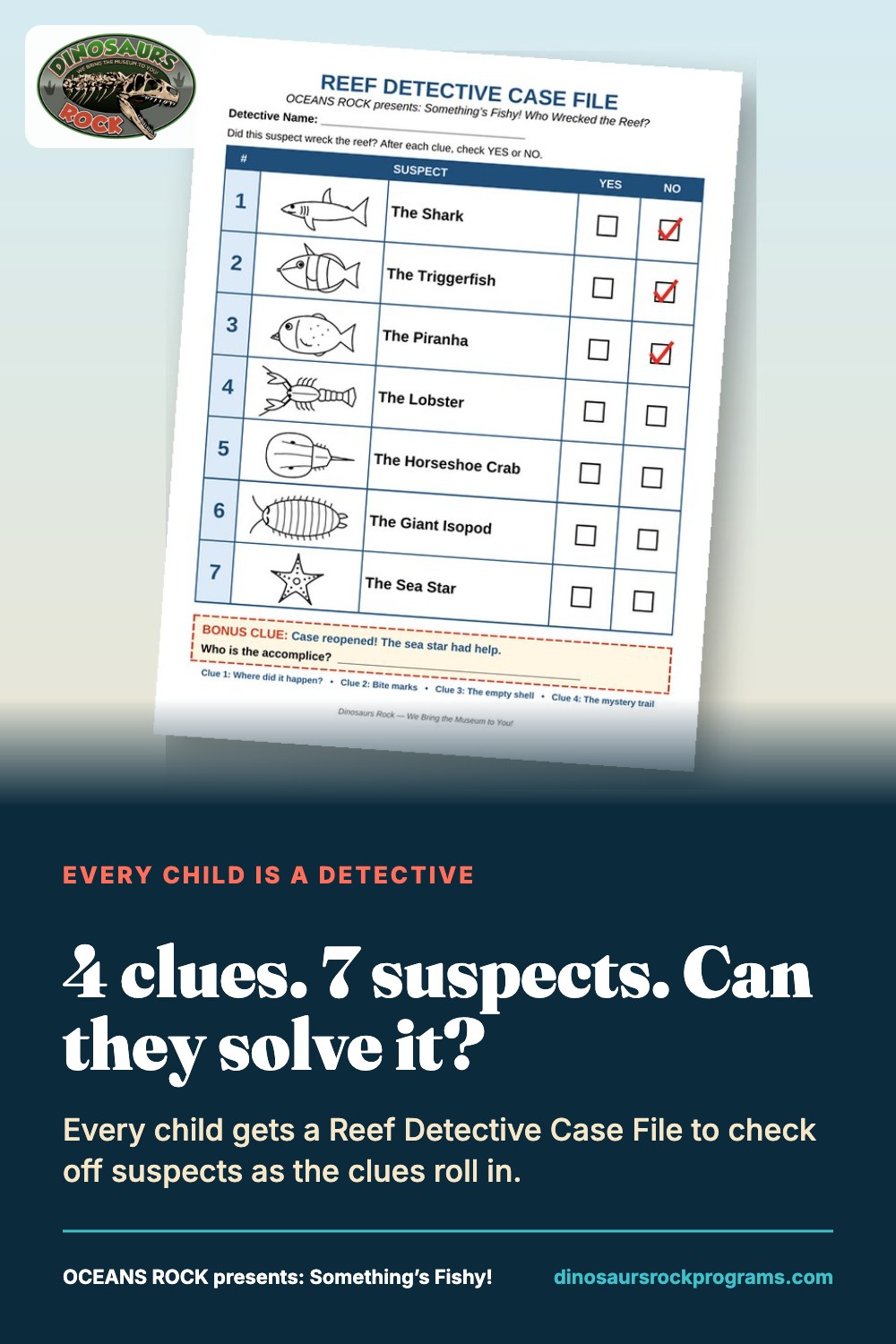
A simple worksheet with each suspect and a YES or NO box keeps everyone focused. As clues come in, kids cross suspects off until only one is left.
5. Let the room vote
After each clue, ask for a show of hands. Voting keeps energy high and makes the reveal more exciting.
6. Add a twist
The best mysteries have a surprise ending: an accomplice, a second clue or a suspect who was hiding in plain sight. It sends kids home still talking.
7. End with real evidence they can touch
Real specimens make the case feel real. If you can, finish with a hands-on activity where kids hold, examine or dig for the actual “evidence.”
A science mystery we built for libraries
Our 2027 summer reading program, OCEANS ROCK presents: Something’s Fishy! Who Wrecked the Reef?, follows exactly this recipe. A message in a bottle washes ashore from a marine biologist: patches of her coral reef are turning bare overnight. Seven sea creatures are suspects:
- The Shark
- The Triggerfish
- The Piranha
- The Lobster
- The Horseshoe Crab
- The Giant Isopod
- The Sea Star
Genuine specimens of each suspect are on display right in your library. Kids work through four science clues: a salt-water experiment, a comparison of real shark teeth with the damaged coral, a volunteer who “molts” to test the lobster’s alibi, and a mysterious trail. Every child tracks the case in their own Reef Detective Case File. Most kids accuse the shark. They are wrong, and just when they think the case is closed, there is a twist. (No spoilers here. You will have to book the program to find out who wrecked the reef.)
The program ends with our Sea Fossil Dig, where every child keeps two genuine treasures, including fossil coral more than 200 million years old. It runs 45 to 50 minutes for ages 4 to 12 and their families.
Bring the mystery to your library
DINOSAURS ROCK has brought the museum to libraries, schools and families for 27 years across NJ, NY, CT, PA, MA, RI, MD, VA and CA. Pricing is based on audience size and travel. Call 917-375-4248 for a no-obligation quote and to hold your 2027 date, or email dinosaursrock2@gmail.com.
Science mystery FAQ
What age is best for a science mystery program?
Ages 4 to 12 is a great range. Younger kids follow the story and the voting, and older kids work through the clues.
Does a mystery program fit the 2027 summer reading theme?
Yes. The 2027 theme is mystery, detective and suspense, with the slogan Mysteries Await at Your Library.
Who wrecked the reef?
That’s a secret! The answer is revealed live in the program, so your young detectives can solve it themselves.
Save this guide for later
Pin it to your Pinterest board so it’s there when you need it.
Written by DINOSAURS ROCK founder Neil Brown.
