
When you think of dinosaurs, you might picture Montana or the Gobi Desert. But New Jersey has one of the most important dinosaur stories in the world. The first nearly complete dinosaur skeleton ever found came out of a marl pit in Haddonfield. A fierce cousin of T. rex was dug up in Gloucester County. And dinosaur footprints are preserved in rock in northern New Jersey. Here is who lived in the Garden State, and where you can see them today.
What New Jersey looked like in the age of dinosaurs
New Jersey’s dinosaur story comes in two chapters.
- The Triassic and early Jurassic (about 200+ million years ago): northern New Jersey sat in a rift valley with lakes and mudflats. Early dinosaurs walked along the shores and left footprints in the mud.
- The Late Cretaceous (about 80 to 66 million years ago): much of southern and central New Jersey was a coastal plain at the edge of a warm, shallow sea. Dinosaurs lived along the coast, and when they died, some were washed out to sea and buried in sea-floor sediments that became the greenish “marl” that 1800s farmers dug for fertilizer. That is how many of New Jersey’s dinosaurs were found.
Hadrosaurus foulkii: New Jersey’s state dinosaur
In 1858, William Parker Foulke dug the bones of a large, plant-eating duck-billed dinosaur out of a marl pit in Haddonfield, Camden County. Scientist Joseph Leidy named it Hadrosaurus foulkii. It was the most complete dinosaur skeleton known at the time, and it proved that some dinosaurs walked on two legs.
In 1868, its skeleton was mounted at the Academy of Natural Sciences in Philadelphia. It was the first dinosaur skeleton ever mounted for display anywhere in the world, and crowds poured in to see it. In 1991, New Jersey made Hadrosaurus its official state dinosaur. The discovery site in Haddonfield is now a National Historic Landmark, and a statue of Hadrosaurus stands in downtown Haddonfield.
Dryptosaurus: New Jersey’s “tearing lizard”
In 1866, workers at the West Jersey Marl Company near Barnsboro in Gloucester County uncovered the bones of a large meat-eating dinosaur. Paleontologist Edward Drinker Cope named it Laelaps. That name had already been used for another animal, so his rival Othniel Charles Marsh renamed it Dryptosaurus, meaning “tearing lizard,” in 1877.
Dryptosaurus was a tyrannosauroid, an early relative of T. rex, with large hand claws. It was one of the first meat-eating dinosaurs known from a partial skeleton in North America. The rivalry it fueled between Cope and Marsh grew into the famous “Bone Wars.” Today the New Jersey State Museum in Trenton displays two Dryptosaurus skeletons posed in battle.
New Jersey was so central to early dinosaur science that, according to the New Jersey State Museum’s longtime natural history curator, for about 20 years most American dinosaurs came from New Jersey.
The footprint makers of northern New Jersey
Bones aren’t the only dinosaur fossils. In northern New Jersey, early Jurassic and late Triassic rocks preserve thousands of dinosaur footprints. Most are three-toed tracks made by small and medium-sized meat-eating dinosaurs. One of the best-known sites is the Riker Hill Fossil Site in Roseland, Essex County, a former quarry famous for its dinosaur tracks and a National Natural Landmark.
Scientists give footprints their own names, such as Grallator and Eubrontes, because we usually can’t tell exactly which dinosaur made them. Kids love comparing their own feet to a dinosaur track. At DINOSAURS ROCK programs they can measure their feet against a T. rex footprint.
New Jersey’s other prehistoric giants (not dinosaurs!)
- Mosasaurs: huge marine reptiles that ruled the Cretaceous seas. The New Jersey State Museum displays a 50-foot cast of Mosasaurus maximus collected in southern New Jersey.
- Deinosuchus: a gigantic crocodile relative whose fossils have been found in New Jersey.
- Icarosaurus: a small gliding reptile from the Triassic, found in a North Bergen quarry by teenagers in 1960.
- Sharks: fossil shark teeth are everywhere in the Cretaceous layers. See where to find shark teeth in NJ.
- Mastodons: much later, in the Ice Age, mastodons roamed northern New Jersey. Their skeletons have been dug up in Sussex County.
Where to see New Jersey dinosaurs today
- New Jersey State Museum, Trenton: Hadrosaurus, Dryptosaurus and a giant mosasaur in its natural history exhibits.
- Edelman Fossil Park & Museum, Mantua Township: Rowan University’s museum, which opened in 2025 at a former marl quarry with a 66-million-year-old bone bed.
- Hadrosaurus foulkii Leidy Site and statue, Haddonfield: visit the spot where it all began.
- Academy of Natural Sciences, Philadelphia: just across the river, where Hadrosaurus was first displayed in 1868.
- Riker Hill Fossil Site, Roseland: check Essex County Parks for visiting information.
- Big Brook, Monmouth County: hunt for Cretaceous fossils yourself. A hadrosaur bone was found there in 2008.
Bring New Jersey’s dinosaurs to your school
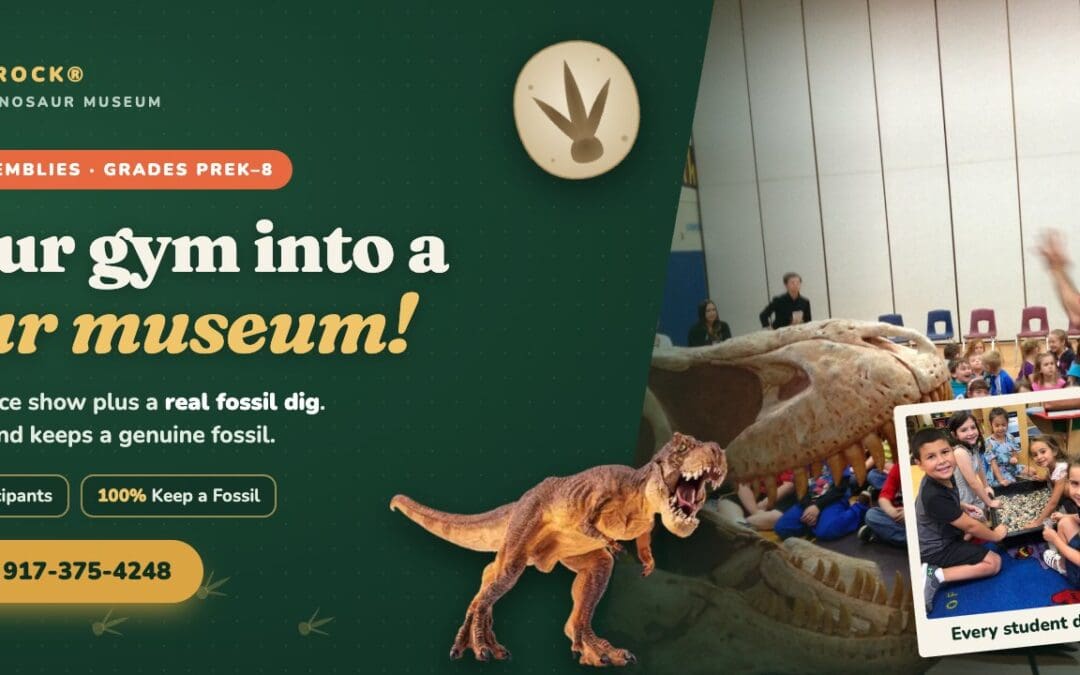
The DINOSAURS ROCK® school assembly brings a full museum of genuine fossils into your gym, and every student keeps a real fossil. It is a perfect fit for New Jersey science standards on fossils, Earth’s history and how environments change. We serve schools across the state, including Camden & Gloucester, Monmouth & Ocean and Bergen counties. Planning a party? See our dinosaur birthday parties.
New Jersey dinosaur FAQ
What is New Jersey’s state dinosaur?
Hadrosaurus foulkii, a duck-billed plant eater found in Haddonfield in 1858. It became the state dinosaur in 1991.
Did T. rex live in New Jersey?
No T. rex fossils have been found in New Jersey. But its relative Dryptosaurus, a tyrannosauroid, lived here near the end of the Cretaceous.
Can you find dinosaur fossils in New Jersey?
Dinosaur bones are very rare finds, but they do turn up. Fossil shark teeth, shells and other sea creatures are much more common, and you can legally collect them in places like Big Brook by following the rules.
Save this guide for later
Pin it to your Pinterest board so it’s there when you need it.
Written by DINOSAURS ROCK founder Neil Brown.
