
Last Updated: October 28, 2026
Quick Summary
An educational birthday party gives children a memorable day with hands-on learning and something to take home. Programs built around digs, sorting, and specimen discovery keep every child busy and learning throughout the party.
- Each child discovers and keeps their own authentic specimens
- A two-hour party works best as a sequence of blocks, not a list of activities
- Scavenger hunt clues should each be a short classification task
- Skip activities with open flames, strong smells, or long waits between steps
- Name and practice group roles like Finders, Sorters, and Recorders before the first activity
Table of Contents
- Why Choose an Educational Birthday Party for Kids?
- Science Birthday Party Ideas That Kids Actually Remember
- Dinosaur Birthday Party Ideas With Learning Built In
- Hands-On Birthday Party Activities for Mixed Ages
- Booking a Dinosaur Program or Planning Your Own at Home
- Frequently Asked Questions
Why Choose an Educational Birthday Party for Kids?
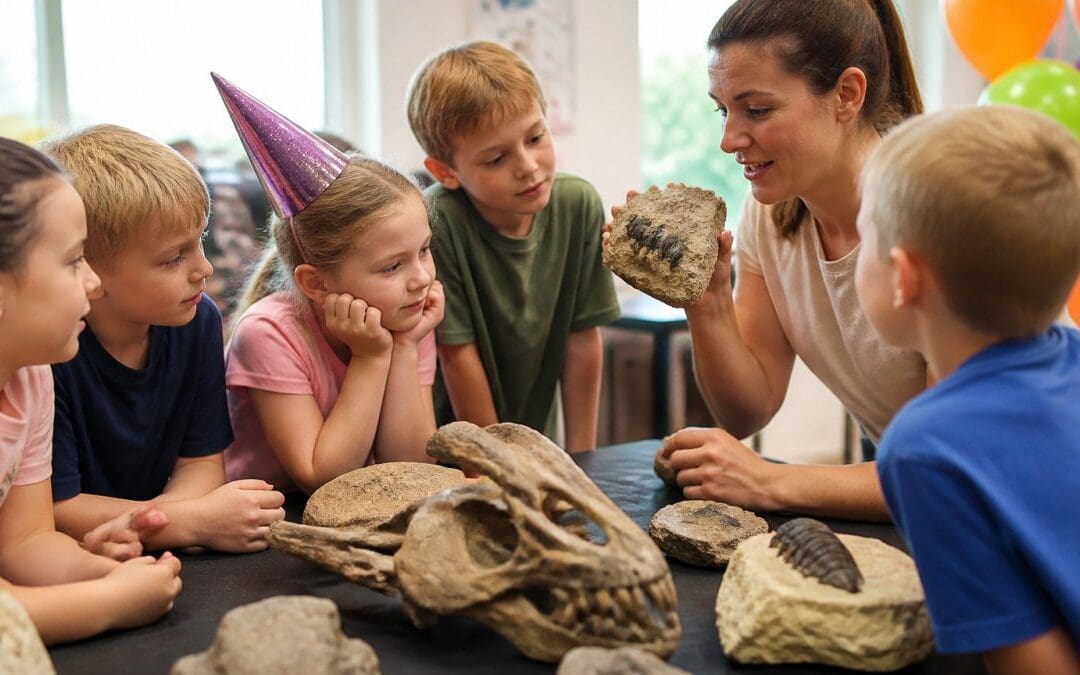
An educational birthday party for kids gives children a memorable day and something they can take home. Dinosaurs Rock, a company with 27 years of experience, designs its programs around hands-on learning rather than costumes or entertainment acts. Children can discover and keep their own authentic specimens.
- Kids discover and keep their own authentic specimens
A common question from parents is whether one program can work for a 4-year-old and an 11-year-old at the same time.
Science Birthday Party Ideas That Kids Actually Remember
Most party guides list science activities as a menu, pick one, add cake. The gap is structure: a two-hour party needs a sequence, not a list. Below is a workable curriculum built around a single main activity, with each block tied to a specific skill kids practice. This is the part most guides skip.
A two-hour STEM party curriculum
| Time | Block | What kids do | Skill practiced |
|---|---|---|---|
| 0:00-0:15 | Arrival and prediction | Look at a specimen tray and circle a guess on a card: “Is this a rock, a fossil, or a shell?” | Observation, hypothesis |
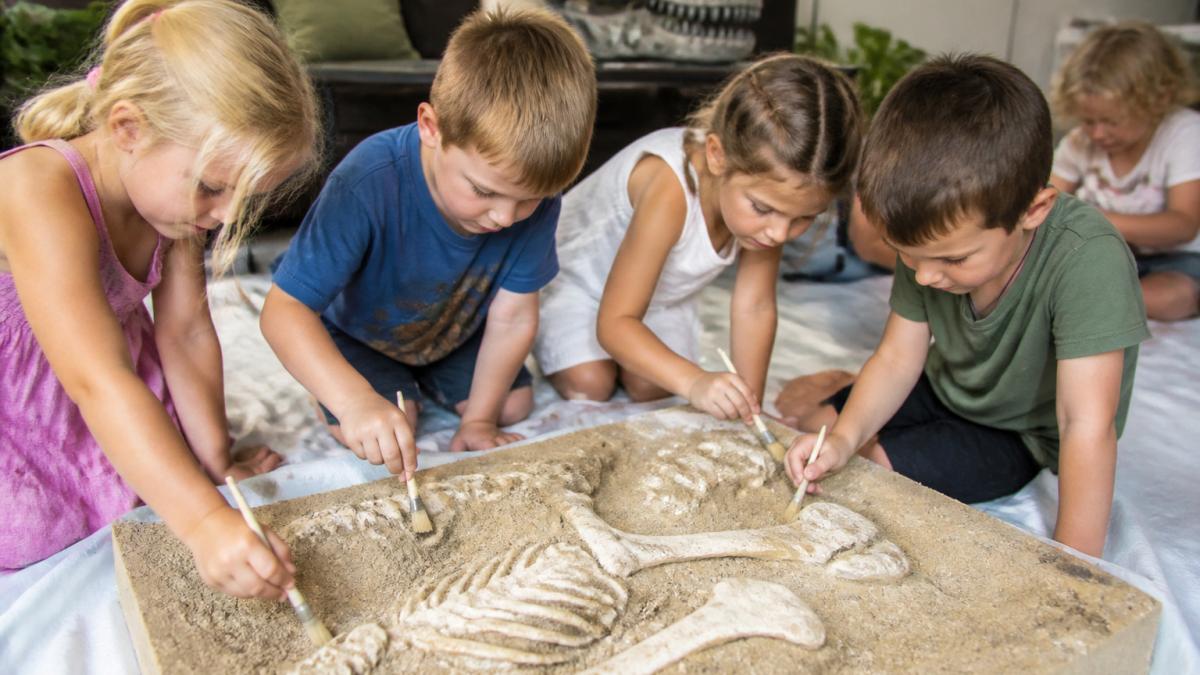
| 0:15-0:45 | Main dig | Dig, brush, and uncover a specimen | Fine motor, patience, tool use |
| 0:45-1:00 | Sort and classify | Group finds by size, type, or texture on a sorting mat | Classification, comparison |
| 1:00-1:20 | Snack and question wall | Eat, then post one question on a sticky note wall | Curiosity, language |
| 1:20-1:45 | Identify and log | Match finds to a picture key and fill in a field log | Matching, recording |
| 1:45-2:00 | Share and take home | Each child shows one find and says one thing they learned | Communication, reflection |
Fossil digs and gemstone hunts
Dinosaurs Rock’s programs include a dig where every child keeps the specimen they find.
Scavenger hunts and outdoor exploration
To tie the hunt to learning outcomes, build the clues around one concept, for example, “find something that was once alive,” “find something that has never been alive,” or “find three different textures.” Each clue becomes a short classification task rather than a race to the next card. A hunt built this way takes about 25 minutes for 8-10 clues and ends with a group sort of everything found.
What to skip
Not every science activity survives a party setting. Skip anything with open flames, strong smells, or long wait times between steps. A volcano that needs 10 minutes to fizz leaves 15 kids watching a cup. A dig, a sort, or a hunt keeps every child’s hands busy for the whole block, which is the real test of whether an activity belongs at a party. Choosing materials that serve a dual purpose as both entertainment and eco friendly gifts ensures that the excitement of the event lingers long after the guests have departed.
Dinosaur Birthday Party Ideas With Learning Built In
Dinosaurs Rock uses life-size, moving, and roaring dinosaur exhibits as part of its programs.
Hands-On Birthday Party Activities for Mixed Ages
Print the field log on a half-sheet so it fits on a clipboard. Kids who finish early can start the next station without waiting.
Many planners find that group activities with simple roles reduce boredom for both age groups, but the roles have to be named, posted, and practiced once at the start. A two-minute walkthrough of “Finders, Sorters, Recorders” before the first activity is the difference between a party that runs itself and one that needs constant adult redirecting.
Booking a Dinosaur Program or Planning Your Own at Home
Parents, schools, and group leaders can either book a program or plan the party themselves.
For current pricing, dates, and availability, contact Dinosaurs Rock directly by calling (917) 375-4248 or visiting their website. Pricing depends on quantity, dates, and delivery, so ask for a quote tailored to your event.
Every child can discover and keep their own authentic specimens.
Frequently Asked Questions
What are some unique educational birthday party themes for kids?
Strong educational themes include dinosaurs and paleontology, rocks and gemstones, space and astronomy, volcanoes and weather, and simple chemistry. Each theme gives kids a reason to explore: they can dig for fossils, sort minerals by hardness, or build a model solar system. Choose a theme your child already loves, then add one hands-on activity that teaches a single concept. Keeping the learning concrete and tied to play is what makes the party feel like fun rather than class.
What are fun science birthday party activities for kids?
Good science party activities include baking soda and vinegar volcanoes, slime making with a lesson on polymers, color-changing milk experiments, and simple circuits with batteries and LED lights. Set up stations so each child completes one experiment and takes a result home. Ask guests to predict what will happen before each step, which turns a simple reaction into a short investigation. Plan roughly 10 to 15 minutes per station to keep younger children focused.
How do you plan an educational birthday party at home?
Start by choosing one theme and two or three hands-on activities that teach related ideas. Build a simple run-of-show with timed stations, a short opening, and a closing where kids share what they discovered. Prepare supplies in labeled bins and set up a table for each activity. Scale activities by age: younger children can sort and dig, while older kids can measure, record observations, or design their own experiment. Send invitations that mention the theme so guests arrive curious.
Can one educational party work for kids of different ages?
Yes. Dinosaurs Rock offers hands-on programs where children can discover and keep their own authentic specimens.
Ready to plan an educational party that kids will talk about for weeks? Call Dinosaurs Rock at (917) 375-4248 to ask about programs for your next birthday, school event, or group visit.

