
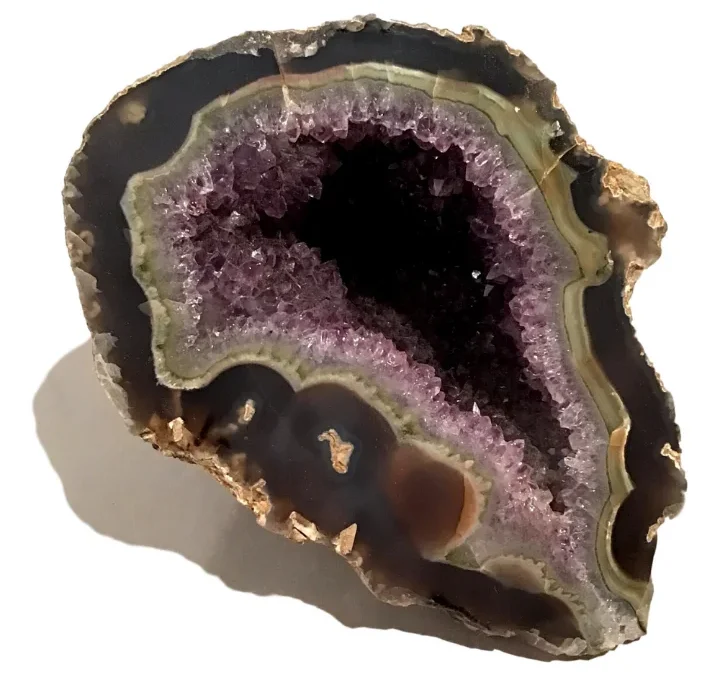
From the outside, a geode looks like a plain, lumpy, round rock, the kind you might step right over on a hike. Crack it open, and a hidden cave of sparkling crystals appears. It is one of the best surprises in nature. So how does a crystal cave end up inside a rock? Here is the simple answer, and the fascinating details.
The short answer
A geode forms when a hollow space inside a rock slowly fills with crystals. Mineral-rich water seeps into the hollow, and over thousands to millions of years, minerals left behind by the water grow into crystals that line the inside walls. If the hollow fills up completely, it becomes a solid “nodule” instead of a geode.
Step by step: how a geode forms
- A hollow forms. First, there has to be an empty space inside a rock. It might be a gas bubble trapped in cooling lava, or a pocket left behind in limestone.
- A hard outer shell develops. The outer wall of the hollow is often lined with tough, fine-grained silica such as chalcedony. That shell is why geodes survive long after the softer rock around them wears away.
- Mineral-rich water seeps in. Groundwater carrying dissolved minerals, most often silica, trickles into the hollow through tiny pores and cracks.
- Crystals grow. As the water changes or evaporates, minerals come out of the solution and attach to the walls, layer by layer. Crystals grow inward toward the center, pointing into the open space.
- Time does the rest. This happens incredibly slowly, over thousands to millions of years. Eventually erosion frees the geode from the surrounding rock, and it waits for someone to find it.
The two main ways geodes form
Volcanic geodes
When lava cools, gas bubbles get trapped inside it, leaving round holes in rocks like basalt and rhyolite. Later, silica-rich water fills these holes with agate, quartz and sometimes purple amethyst. Many of the world’s big amethyst geodes come from volcanic rocks in Brazil and Uruguay, and Mexico is famous for geodes that form in volcanic ash deposits.
Sedimentary geodes
Other geodes form in sedimentary rocks like limestone. A pocket or a mineral lump in the rock dissolves or shrinks, leaving a space that slowly fills with quartz, calcite or other minerals. The famous Keokuk geodes from the area where Iowa, Missouri and Illinois meet formed this way, and the geode is Iowa’s official state rock.
What’s inside a geode?
- Clear or milky quartz, the most common crystal inside geodes
- Amethyst, purple quartz colored by traces of iron
- Agate and chalcedony, smooth, banded layers of microscopic quartz
- Calcite, often blocky or pointed crystals that are softer than quartz
- Celestine, delicate pale-blue crystals
The minerals depend on what was dissolved in the water, which is why no two geodes are ever exactly alike.
Geode, nodule, thunderegg or vug?
- Geode: a rounded rock with a hollow center lined with crystals.
- Nodule: the same idea, but the inside filled in completely, so there’s no hollow.
- Thunderegg: a type of nodule that forms in volcanic rock, often with a star-shaped agate center.
- Vug: a crystal-lined cavity that is still part of a larger rock rather than a separate round stone.
How to tell if a rock is a geode
- It is roughly round, often with a bumpy, cauliflower-like outside.
- It may feel lighter than a solid rock of the same size, because it is hollow inside.
- Some geodes rattle when you shake them, if loose crystals are inside.
- It is found in an area known for geodes.
How to open a geode safely
- Put on safety glasses. Rock chips fly.
- Place the geode in an old sock or a towel to keep the pieces together.
- Tap it gently with a hammer on a hard surface, turning it as you go, until it cracks. Steady taps work better than one big hit.
- For a clean split, collectors use a chain-style “snap cutter” or a rock saw.
- Kids should always have an adult do the hammering or supervise closely.
Crack your own geode with DINOSAURS ROCK
Breaking open a geode is the number one thing kids ask for at our programs. At our GEMS ROCK® school assembly, students explore the rock cycle, watch geodes cracked open and mine for real gems. You can choose a geode and watch us split it at our booth at the NJ Gem Show in Edison, and geodes are a favorite at our Gems Rock birthday parties. They also make party favors kids actually keep.
How do geodes form? FAQ
How long does it take for a geode to form?
Thousands to millions of years. Crystals grow extremely slowly as minerals build up layer by layer.
Are geodes rare?
Not especially. Geodes are found around the world, but ones with large, colorful crystals, like big amethyst geodes, are much less common.
Why are some geodes purple?
Purple geodes contain amethyst, a form of quartz that gets its color from traces of iron and natural radiation in the rock.
Can you find geodes in New Jersey?
New Jersey isn’t known for classic round geodes, but crystal-lined pockets do occur in some of the state’s rocks. Most geodes sold at gem shows come from places like Mexico, Morocco, Brazil and the Midwest.
Save this guide for later
Pin it to your Pinterest board so it’s there when you need it.
Written by DINOSAURS ROCK founder Neil Brown.
